
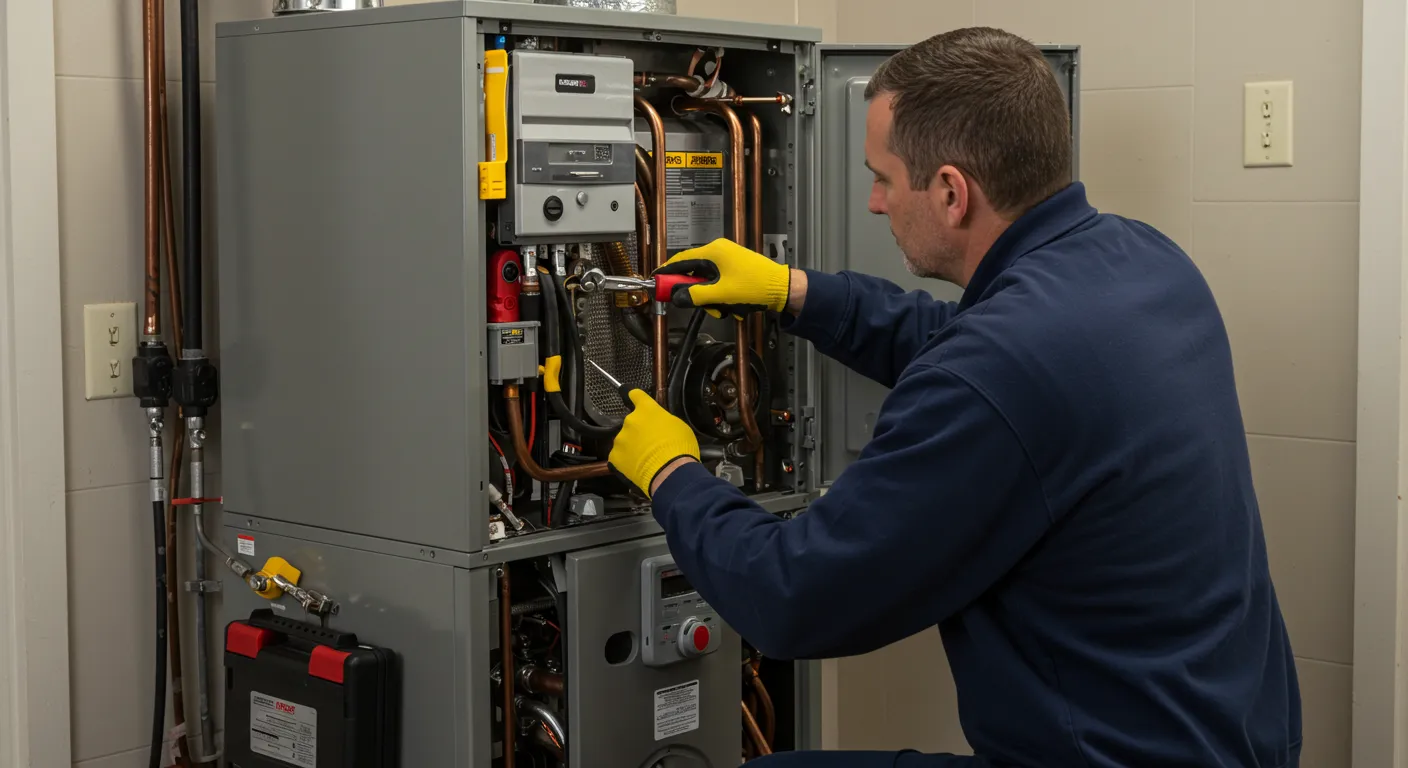
Aurora's ranches are furnace country, but drive west into Denver's older neighborhoods — Park Hill, Washington Park, the pre-war streets — and you're in boiler territory: cast-iron radiators, baseboard loops, in-floor radiant. Boilers inspire strong feelings and stronger myths. Here's the maintenance they actually need, what breaks, and the honest math on keeping one versus converting to forced air.
On this page
How boilers differ (and why the advice differs)
A boiler heats water, not air, and circulates it through radiators, baseboards, or in-floor tubing. No ducts, no blower, no filters. The heat is radiant and even — no drafts, no dust blown around, silent operation. Boiler devotees aren't romanticizing; radiant heat genuinely feels better than forced air.
The trade: boilers are slower to respond (that thermal mass takes time), harder to add cooling to (no ducts for AC — mini-splits become the cooling answer), and the equipment is more expensive. A boiler is a 25–30 year appliance; a furnace is 15–20. That longevity changes all the repair math.
Maintenance a boiler actually needs
- Annual service: burner cleaning and combustion check, circulator pump inspection, expansion tank pressure check, relief valve test, and water chemistry glance. Less frequent than furnace maintenance but not optional.
- Pressure watch: learn your system's normal pressure (usually 12–15 psi cold). Pressure dropping repeatedly means a leak or a failed expansion tank; pressure climbing means the fill valve or expansion tank needs attention.
- Bleed radiators yearly: air trapped at the top of radiators = cold spots. A radiator key and five minutes per radiator each fall.
- Don't drain the system casually: fresh water brings fresh oxygen, which corrodes from the inside. Every unnecessary drain-and-refill ages the boiler. Fix leaks; don't “flush it out” on a schedule.
Common boiler problems and what they cost
- Failed circulator pump (no heat in some/all zones): [TBD] installed — the most common boiler repair, full stop.
- Expansion tank failure (pressure relief valve dripping): [TBD].
- Zone valve stuck (one zone cold): [TBD].
- Control/aquastat issues: [TBD] depending on the control.
- Leaking sections on old cast iron: this is the end-of-life event. Section replacement is sometimes possible but often uneconomical — it's the boiler equivalent of a cracked heat exchanger.
Note the pattern: boiler repairs are fewer but pricier per event than furnace repairs, and the parts are less standardized — which is why you want a company that actually works on boilers, not one that'll “take a look.”
When to convert to forced air (the honest math)
Conversion means: new furnace + new ductwork throughout a house that never had ducts. It's a big project — typically [TBD] all-in — so the bar should be high. Convert when:
- The boiler is dead (leaking sections) and you want central AC — the ductwork serves both, which changes the economics completely.
- You're doing a major remodel anyway and walls are open — ductwork is dramatically cheaper with open framing.
- The distribution system is shot (failed in-floor tubing in a slab, for example) and re-piping costs approach conversion cost.
Don't convert just for efficiency: a new boiler (85–95% efficient) in a house with good radiators will out-comfort a forced-air retrofit every time, for less money. And don't let anyone tell you boilers are “obsolete” — they're a premium heating method that new high-end construction still installs on purpose.
Buying a Denver home with a boiler
Get a boiler-specific inspection, not just a general home inspection — most general inspectors glance at boilers. Ask for: age of the unit, service history, pressure test results, condition of the expansion tank and near-boiler piping, and whether the distribution (radiators/baseboard) is intact. A healthy 15-year-old boiler with records is a plus, not a red flag — it's barely middle-aged.
Boiler vs. furnace: operating cost comparison
The fuel is usually the same (natural gas), so the comparison is efficiency vs. efficiency. A modern 95%-efficient boiler vs. a 96%-efficient furnace: nearly identical fuel cost per BTU delivered. The differences are second-order:
- Distribution losses: forced air loses heat through duct leaks (20–30% in old systems); hydronic pipes lose far less. A boiler with intact piping can beat a furnace with leaky ducts on delivered efficiency even at the same rated efficiency.
- Zoning: boilers zone naturally (one circulator or valve per zone); furnaces need zone dampers retrofitted. Better zoning = less overheating unused rooms = lower bills.
- Cooling: the furnace house adds AC cheaply (ducts exist); the boiler house needs mini-splits. Total-system economics favor the furnace house if cooling matters to you.
Bottom line: don't replace a working boiler to “save on gas.” The fuel savings won't cover the conversion for decades. Replace it when it dies, convert when the distribution fails or you need ducts for AC anyway.
Boiler acting up? Talk to people who work on them
Boiler service, repair, and honest keep-vs-convert assessments for Denver-area homes.
Frequently asked questions
Are boilers more expensive to run than furnaces?
Per BTU, comparable — it depends on the unit's efficiency and your gas rate, not the distribution method. The comfort difference (radiant vs. forced air) is the real distinction, not the bill.
Can you add AC to a boiler-heated home?
Yes — usually via ductless mini-splits, which are ideal here: no ducts to build, zone-by-zone cooling. It's the standard pairing for Denver boiler homes.
My radiators are cold at the top. Problem?
Usually just trapped air — bleed them with a radiator key. If bleeding doesn't fix it or they need it constantly, there's a pressure or circulation issue worth a service visit.
How do I know if my boiler is safe?
Annual service with combustion testing, a working pressure relief valve (tested yearly), and CO detectors in the home — same as any fuel-burning appliance. Boilers are very safe when maintained.
Do boilers need carbon monoxide detectors too?
Absolutely — any fuel-burning appliance does. Same rules: every level, near sleeping areas, replaced every 5–7 years. Boilers are safe, not exempt.
How long does a boiler service visit take?
About 60–90 minutes for a standard residential boiler: burner and combustion check, circulator and expansion tank inspection, relief valve test, radiator bleeding if needed, and a written report. Older or neglected systems take longer — which is exactly why annual service matters more for boilers, not less.
The bottom line: boilers are long-lived, comfortable, premium heat — treat yours like the 30-year appliance it is with annual service, and don't let anyone talk you into converting a healthy boiler. Convert when the boiler dies and you want central AC, or when the distribution system fails. Until then, bleed the radiators every fall, watch the pressure gauge, and enjoy the quietest heat in Denver.
PROUDLY SERVING AURORA, CO 80012