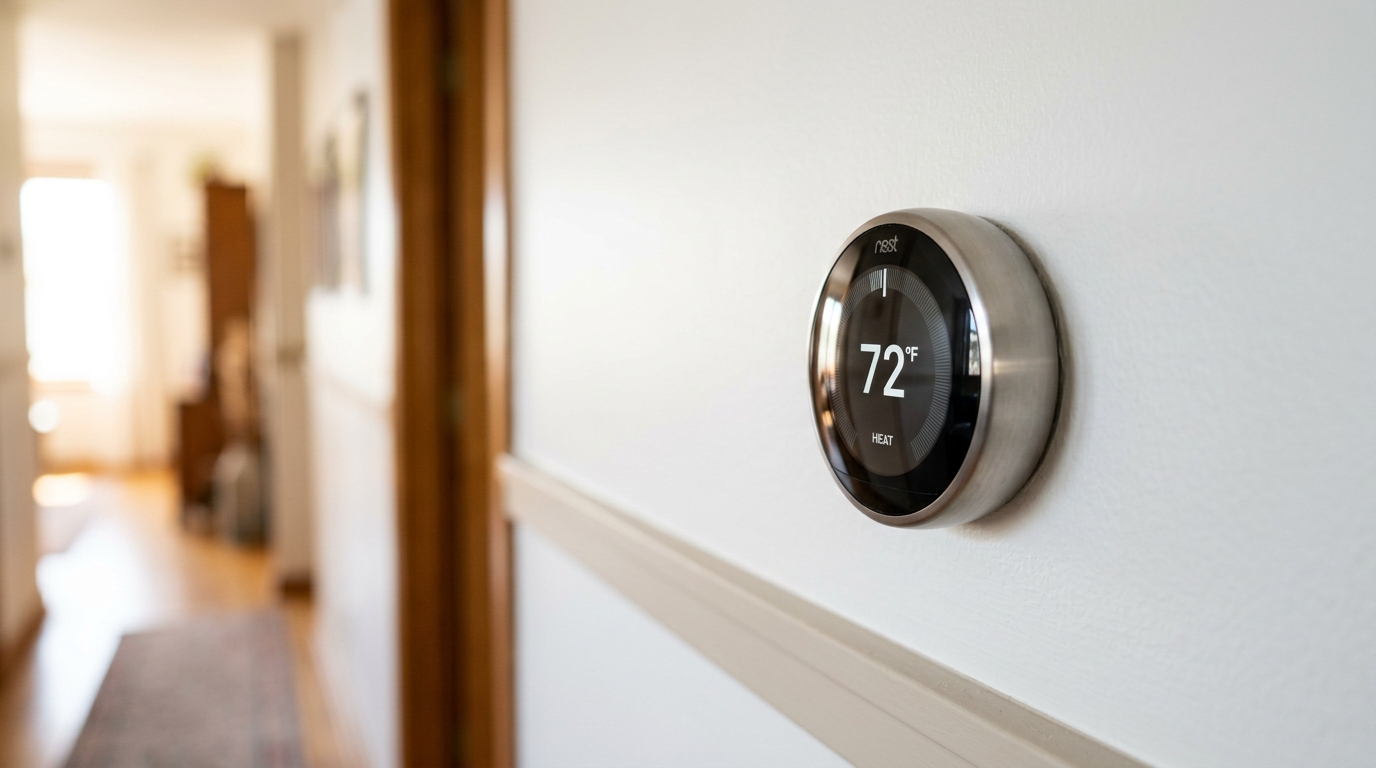
“I'm having issues with my thermostat saying there's no power to the red wire.” We get this call constantly — usually with some panic, because a dead thermostat in January feels like a dead furnace. Good news: the thermostat is the messenger, and the message is usually simple. Here's the 5-minute diagnosis in order, from most likely to least, before you pay for a service call.
On this page
What the message actually means
The R wire (red) carries 24-volt power from your furnace's control board to the thermostat. “No power to R wire” means the thermostat isn't receiving that 24V — so the problem is almost never the thermostat itself. It's the power supply: something between the breaker panel and the furnace interrupted the 24V circuit. That's why replacing the thermostat rarely fixes it, and why this diagnosis starts at the furnace, not the wall.
Step 1: the furnace switch and breaker (60% of calls)
Find your furnace's power switch — it looks like a light switch, usually on or near the furnace, sometimes with a red cover. Someone (kids, a well-meaning guest, you during the holidays) flips these more often than anyone admits. Make sure it's ON.
Then check the breaker panel: the furnace breaker tripped? Reset it once. If it trips again immediately, stop — that's a short or a failing component, and it's tech time. One reset is diagnosis; repeated resets are damage.
Step 2: the condensate float switch (25% of calls)
On high-efficiency furnaces and any system with AC, there's a small float switch in the condensate drain line or pan. When the drain clogs, water rises, the float trips — and it cuts power to the thermostat as a safety measure. The thermostat's “no power” message is actually the system protecting your ceiling from water damage.
Check: is there standing water in the drain pan or around the furnace? Is the drain line visibly clogged? Clearing a clogged condensate line (wet/dry vac on the drain exit, vinegar flush) resolves a huge share of these calls. If water's been sitting, mention it when you call — prolonged overflow can damage the control board.
Step 3: batteries and the C-wire (10%)
Some thermostats run partly on batteries even with a C-wire. Dead batteries + a power blip = the “no power” message. Swap in fresh lithium AAs — cheap, instant, and embarrassingly often the fix.
No C-wire and an older smart thermostat? Power-stealing thermostats can brown out and throw this error intermittently. If the message comes and goes, that's the pattern — and the permanent fix is having a C-wire run, which is a quick tech visit.
Step 4: the furnace door switch (the sneaky one)
The blower compartment door has a safety switch: door ajar = power cut. If someone recently had the filter changed or peeked inside and didn't seat the door fully, the furnace is dark and the thermostat reports no power. Push the door firmly closed until it clicks. This one has ended service calls in under a minute — we're not proud, we're just honest.
When it's actually tech time
If all four check out and the message persists, the 24V circuit has a real fault: blown low-voltage fuse on the control board (often caused by a short in the thermostat wire — sometimes a nail through the wire during a remodel, sometimes rodent damage), a failed transformer, or a control board issue. That's a diagnostic visit: [TBD], waived with repair.
Tell us you ran the 5-minute checklist when you call — it tells the tech exactly where to start, and we'll respect that you did the homework.
After the fix: should you upgrade the thermostat?
Once power's restored, the natural question: is this 15-year-old thermostat worth keeping? Honest guidance:
- Keep it if it's a basic digital that holds programs reliably. A thermostat's job is simple; fancy doesn't heat better.
- Upgrade if: no C-wire and you're on batteries (a new smart stat + C-wire install ends the power-stealing errors permanently), you want remote control and scheduling you'll actually use, or the old unit's temperature swing is 3–4°F (worn anticipator — comfort suffers).
- Skip the $300 flagship unless you'll use its features. The learning algorithms are nice; the energy savings come from the schedule, which a $120 programmable does equally well.
- Heat pump owners: you need a heat-pump-aware thermostat with auxiliary-heat staging. Wrong thermostat here costs real money in backup-heat overuse.
If we ran the diagnostic, we'll tell you straight whether your thermostat contributed to the failure or was just the messenger — and quote the upgrade honestly if it's warranted.
Still dark after the 5-minute check?
We'll trace the 24V circuit, find the break, and get your heat back — thermostat issues are our home turf.
Frequently asked questions
Will resetting the breaker damage anything?
One reset is safe and diagnostic. If it trips again immediately, leave it off and call — repeated resets on a short can damage the transformer or board.
My thermostat has batteries AND a C-wire. Why would batteries matter?
Some models use batteries as backup during power blips; depleted batteries plus a momentary outage can latch the error until fresh batteries go in. It's a cheap first try.
The message comes and goes. What's that?
Intermittent R-wire power usually means a loose wire connection, a float switch tripping and resetting as water drains slowly, or a power-stealing thermostat browning out. All worth a tech visit before it becomes permanent.
Can I just replace the thermostat myself?
You can, but it won't fix a power-supply problem — the new thermostat will show the same message. Diagnose the 24V first; replace the thermostat only if the wiring tests good and the unit itself is faulty.
Could a power outage cause this even after power is restored?
Yes — outages can trip breakers, blow the low-voltage fuse on a surge, or latch the float switch. If the message appeared right after an outage, work the checklist in order; it's usually the breaker or the fuse.
My thermostat screen is dim but not blank. Same problem?
Often the early stage of the same issue — low voltage browning out rather than fully gone. Check the furnace switch and breaker first, then batteries. A dimming display that recovers is worth investigating before it becomes a blank display at midnight.
The bottom line: 'no power to R wire' sounds like a thermostat problem and is almost always a furnace-power problem — the switch, the breaker, the float switch, or the door. Work the five-minute checklist in order before you spend money, and if it comes to a tech visit, tell us what you already checked. We'll take it from there and get your heat back the same visit.
PROUDLY SERVING AURORA, CO 80011